

scientia wiki
An open knowledge base on mining geomechanics. There is a lot in it: definitions and methods, rock mass classifications, formulas and dependencies, worked examples and links to the original sources. All free to read.
History
The Q-system for rock mass classification was developed by Barton, Lien and Lunde in 1974[1]. It expresses rock mass quality as the Q index, on which the design and support recommendations for underground excavations are based.
Formula
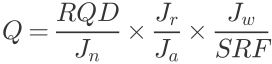
RQD – Rock Quality Designation
Jn – joint set number
Jr – joint roughness number
Ja – joint alteration number
Jw – joint water reduction factor
SRF – stress reduction factor
Handbook on using the Q-system, 2020
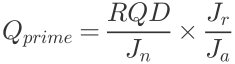
Reduced Qprime or Q′
Since Jw and SRF change in space as mining advances, the rock mass is described with the reduced rating of the Q-system, Qprime. It is most often used in this form in block models.
Rating components [2]
1. RQD (Rock Quality Designation)
RQD measures how fractured the rock is and how well it can keep underground excavations stable.
| RQD value | Description |
|---|---|
| 0–25 | Very poor (many small fragments, many joints) |
| 25–50 | Poor (many joints, small fragments) |
| 50–75 | Fair (some large fragments, still many joints) |
| 75–90 | Good (large fragments, few joints) |
| 90–100 | Excellent (almost no joints, single small fragments) |
Definition
RQD – quality index of core recovered from a borehole. [1]
Rock Quality Designation, RQD (%) – the ratio of the total length of intact core pieces longer than 10 cm to the length of the drilled interval. [2]
Counting RQD
We measure all intact pieces
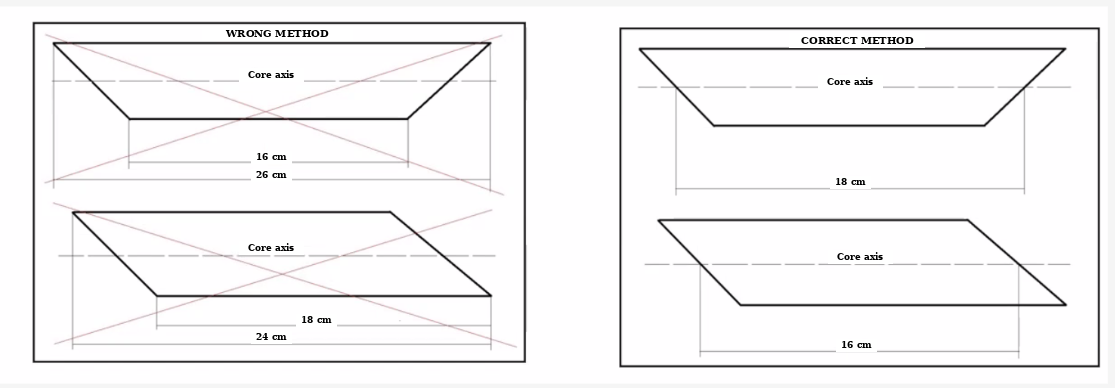
Only open natural joints are counted. Joints subparallel to the core axis are not counted.

Categories
By RQD, rock is classified according to the table [3]
| No | RQD | Quality | Rating |
|---|---|---|---|
| 1 | 0–25 | Very poor | Worse |
| 2 | 25–50 | Poor | Poor |
| 3 | 50–75 | Fair | Fair |
| 4 | 75–90 | Good | Good |
| 5 | 90–100 | Excellent | Excellent |
Definition
Uniaxial compressive strength (UCS, σc) is the stress at which a rock specimen fails under compression acting along a single axis. It is one of the key mechanical properties of rock in geomechanics.
It is determined by laboratory testing or by indirect methods.
Laboratory test standards
• GOST 21153.2-84
• ASTM D7012 (compressive strength of intact rock core)
• ISRM Suggested Method
Typical values
| Igneous rock | UCS, MPa |
|---|---|
| Granite | 80–380 |
| Diorite | 140–310 |
| Syenite | 100–220 |
| Gabbro | 190–320 |
| Andesite | 80–260 |
| Basalt | 90–460 |
| Sedimentary rock | UCS, MPa |
|---|---|
| Dolomite | 12–150 |
| Siliceous limestone | 140–240 |
| Clayey limestone | 24–35 |
| Sandstone | 5–150 |
| Siltstone | 12–40 |
| Rock salt | 26–28 |
Elastic modulus from UCS
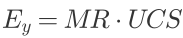
where MR (modulus ratio) is taken for each rock type from the table:
| Rock | MR |
|---|---|
| Andesite | 400 ± 100 |
| Basalt | 350 ± 100 |
| Diorite | 325 ± 25 |
| Rhyolite | 400 ± 100 |
Definition
GSI (Geological Strength Index) is an empirical parameter used to estimate the strength and deformability of jointed rock masses. It was introduced by E. Hoek and P. Marinos in 1995 as a way to classify rock masses by their structure and the condition of joint surfaces.
It is one of the most widely used geomechanical rock mass ratings.
How it is estimated
GSI is assessed visually from the rock mass structure (block size and shape) and the condition of joint surfaces (weathering, infilling and roughness). The classic approach uses the Hoek–Marinos chart, where the index ranges from 10 (crushed rock) to 100 (intact rock).
• Structure: degree of fracturing, block size and interlocking
• Joint surfaces: weathering, infilling, roughness
Formulas
Rock mass strength (Hoek–Brown)
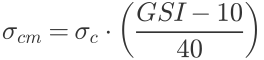
σcm – rock mass strength, σc – strength of intact rock.
Rock mass deformation modulus

Em – rock mass modulus, Ei – intact rock modulus (Ei = UCS · MR).
Typical MR values
| Rock | MR |
|---|---|
| Sandstone | 200–350 |
| Siltstone | 350–400 |
| Conglomerate | 300–400 |
| Crystalline limestone | 400–600 |
Overview
The Schmidt hammer (rebound hammer, sclerometer) is a portable tool for estimating the elastic and strength properties of rock and concrete. Developed in the 1940s by Swiss engineer Ernst Schmidt, it is widely used in geotechnics and geomechanics for non-destructive testing of rock.
How it works
The hammer measures how far a spring-loaded mass rebounds after striking the rock surface. The body holds the plunger, the spring and a scale that records the rebound. The rebound value correlates with the strength and elastic properties of the material.
Converting to UCS
Most reliable relationship:
 (r = 0.94)
Take 20 impacts and discard the 10 lowest readings. The large number of measurements makes up for the low precision of a single one.
Use in geomechanics
The Schmidt hammer is used to estimate rock strength directly at the deposit, reducing the number of samples needed for laboratory testing. Its readings are used to classify rock by strength.
Advantages
• Portable and easy to use
• Fast strength estimates in the field
• Cheaper than laboratory testing
Limitations
• Results depend on the operator and test conditions
• Heterogeneous rock can distort readings
• Best suited to intact or slightly jointed rock
Rock Mass Rating (RMR)
An engineering rock mass classification developed by Bieniawski in 1973. It uses six rock mass parameters:
1. Uniaxial compressive strength of intact rock
2. Rock Quality Designation (RQD)
3. Spacing of discontinuities
4. Condition of discontinuities:
length (persistence), aperture, roughness, infilling, weathering
5. Groundwater conditions
6. Orientation of discontinuities
All parameters are measured in the field, and some can be obtained from borehole data. The ratings of the parameters are summed to give the RMR value.
Applying the classification
The rock mass along the opening is divided into structural regions in which the geological features are more or less uniform. The six parameters are determined for each region from field measurements and rated using Table 1. Typical, not worst-case, conditions are assessed.
Rock mass classes
| RMR | Class | Description |
|---|---|---|
| 81–100 | I | Very good rock |
| 61–80 | II | Good rock |
| 41–60 | III | Fair rock |
| 21–40 | IV | Poor rock |
| < 21 | V | Very poor rock |
There is much more on the wiki: over 200 articles on mining geomechanics.
Keep turning to open it →